The crypt and its ossuary
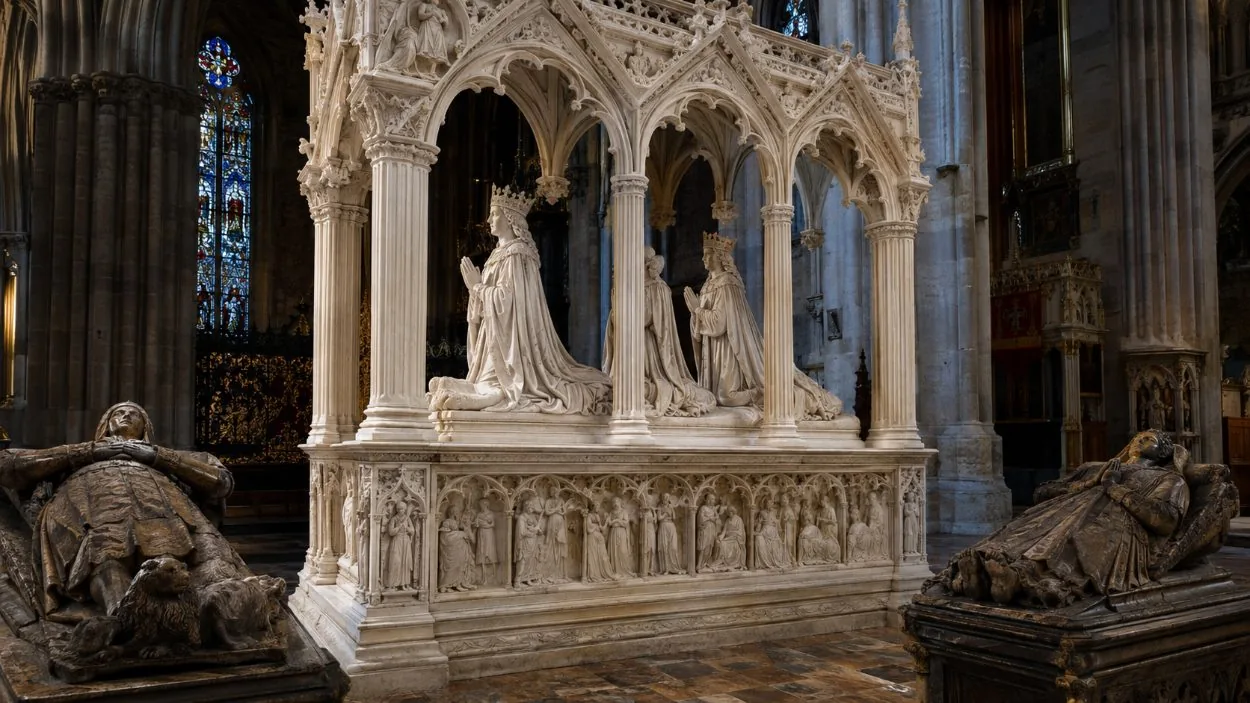
What you find when going down
You descend from the ambulatory. The crypt is the oldest and lowest part of the building, where people speak more softly without having agreed to. It stays cool all year round. It is also the part that hurried visitors skip, because they have already spent forty minutes in the transept and think they have seen the essentials. This is a mistake: without the crypt, the visit tells only half the story.
The ossuary, and what it contains
In 1793, by decree of the Convention, the tombs were opened and the remains thrown into two mass graves north of the church, with lime. In 1817, Louis XVIII had these bones recovered. It was already impossible to know which bone belonged to whom: the lime, time, and the mixing of bodies. They were therefore placed together in an ossuary in the crypt, behind a plaque listing the sovereigns concerned. The full account of the episode is on the desecration page.
This means, very concretely, that Louis XIV, Henri IV, Francis I and dozens of others are physically in the same place, indistinguishable. The tomb of Francis I that you have just admired in the transept is an empty monument. I find that this sentence, said before the visit, changes the way you look at things — for the better. It also avoids the disappointment of those searching for "the tomb of" someone. The question comes up so often for Louis XIV that I have devoted an entire page to it.
The plaque
You do not see any bones. You see a plaque with engraved names. It is sober, almost administrative, and that is what makes it striking: eleven centuries of monarchy, from Dagobert in 639 to the Revolution, summed up in a list. Take the time to read it in full. The official count — forty kings, twenty-six queens, sixty princes and princesses, around ten servants of the monarchy — is detailed on the page on who is buried here.
The two exceptions in the crypt
Louis XVI and Marie-Antoinette are not in the ossuary. Their remains, buried in the Madeleine cemetery after 1793, were recovered and brought back to Saint-Denis in January 1815, thus identified as such. This is the only case where one can truthfully say that a specific person rests here. Their praying statues, however, are on the transept level. See their page and, for the question of the head, Marie-Antoinette’s page.
What works
- The oldest and quietest part of the monument
- The ossuary concludes the visit with its logical ending
- Cool in summer, pleasant after the transept
- Included in the ticket, no extra charge
Good to know
- The bones are not visible, only a plaque
- Uneven floor and steps: see the accessibility page
- Often skipped by hurried visitors
- Low light: photography without flash is difficult
Descend last, after the gisants, never before. The crypt is understood as the end of the story: you have seen the faces, then you read what remains of them. The route in order is on que voir.
Why the crypt is the oldest part of the monument
The building visited above dates from two major campaigns: the choir of Suger, consecrated on 11 June 1144, and the nave rebuilt from 1231 under Louis IX by Pierre de Montreuil. The crypt, however, lies beneath all this, at the level of the original ground, where the martyr's tomb was venerated as early as the 3rd or 4th century. You thus literally descend to the starting point: without this tomb, there would be no abbey, no Suger, no kings. This sequence is explained on pourquoi les rois à Saint-Denis and on la page de saint Denis.
A field observation: this is also the only part of the monument where true silence settles. Above, there are groups, touchscreens, footsteps on the stone. Below, visitors fall silent on their own. On a Thursday morning in January, I saw an entire class of 12-year-olds descend noisily and fall silent by the third step, without the teacher having to say a word.
What to plan for
A quarter of an hour, no less. Steps, an uneven floor, low light: the actual conditions are described on la page accessibilité. Include the crypt in the total la durée de visite, which takes about an hour for a self-guided tour.
Go down into the crypt
Reminder: what you’re booking above is entry to the royal necropolis. The nave, however, remains open without a ticket, as in any church in the diocese.
Frequently asked questions
What does the crypt of Saint-Denis contain ?
The ossuary where the bones recovered from the 1793 pits were deposited in 1817, mixed together, behind a plaque listing the sovereigns. See 1793.
Can the bones be seen ?
No. A plaque and engraved names are visible. The remains are behind it, unassignable. See who is buried here.
Is the crypt included in the ticket ?
Yes, at no extra charge, as are the choir and transept. The nave, however, remains freely accessible: see what is free.
Is it wheelchair accessible ?
Steps and uneven flooring make it difficult. The exact conditions are described on the accessibility page.