What to see, in order
1. The nave, before the ticket
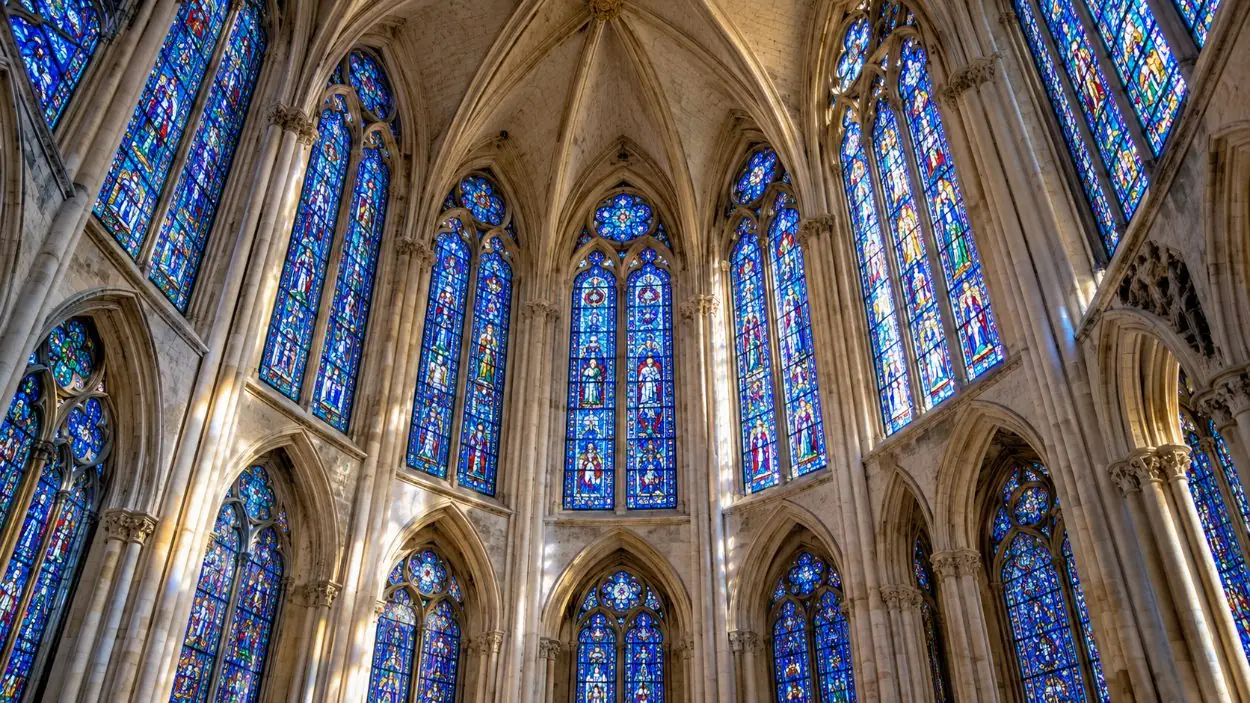
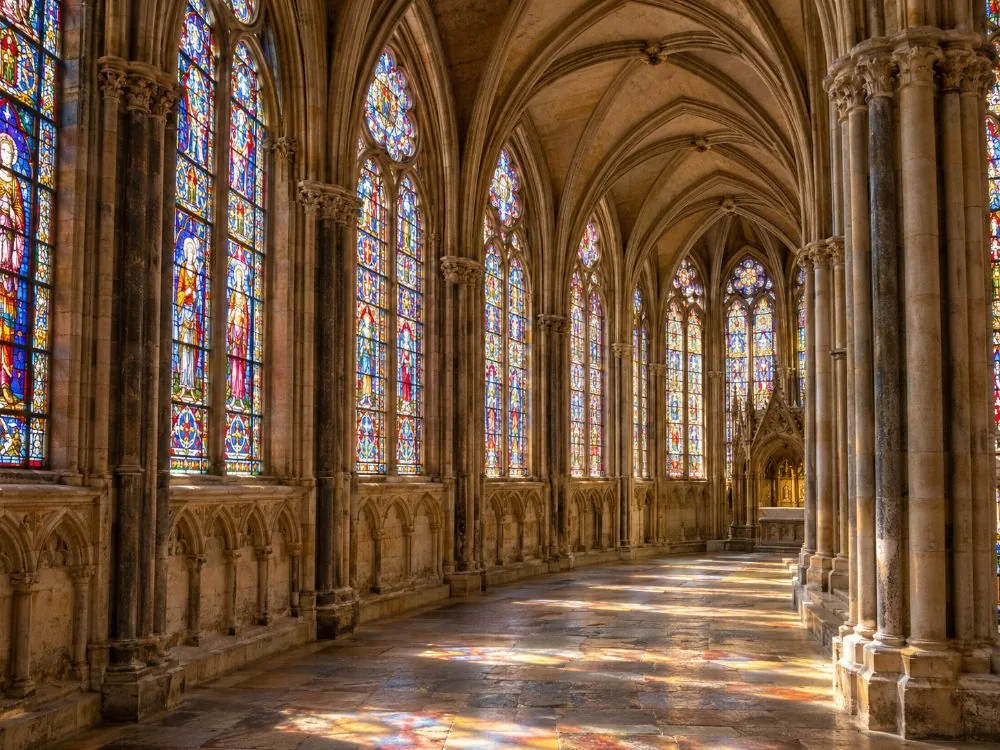
You enter through the western façade. The nave and the high-Gothic transept were rebuilt from 1231 under Louis IX by Pierre de Montreuil : this is Rayonnant Gothic, tall, bright, with stained-glass windows replacing the wall. You can stay here without paying, and many visitors do just that — that’s the mistake this site exists to prevent. Look at the façade as you leave; otherwise, you’ll miss it : there is only one tower, and the explanation is on why there is only one tower.
2. Suger’s choir, the true beginning
After the ticket check, you enter the choir consecrated on 11 June 1144 under Abbot Suger. This is not just another Gothic choir : it is the first. Pointed arches, ribbed vaults, radiating chapels open to one another instead of being partitioned off, and the wall replaced by glass. Suger called this lux nova. Stand in the centre, turn around once, and see how the light flows from one chapel to another without obstruction : this is the invention you came to see. Details on the Suger page.
3. The ambulatory and the stained-glass windows
We walk around the choir. The radiating chapels follow one another, and so do the stained-glass windows. Take the time to make the full circuit rather than cutting through : this is the movement the building was designed to create. In January, it’s cold and the wind gets in ; I mention it because no one else does. The stained-glass windows page explains what to look for.
4. The transept and the gisants
This is the heart of the visit and the reason to come. Over seventy gisants and tombs from the 12th to the 16th century, the largest collection of funerary sculpture from this period in the world. Dagobert and his sculpted comic strip ; Clovis and Childebert ; Charles V, the first face that looks like someone ; Louis XII and Anne of Brittany, the double Renaissance tomb with its transis ; Francis I and Claude of France beneath their triumphal arch ; Henri II and Catherine de’ Medici ; and Bertrand du Guesclin, constable not king, at the feet of the king. Allow at least forty minutes here. One by one, they are on the gisants page.
The praying statues of Louis XVI and Marie-Antoinette, commissioned by Louis XVIII after the return of their remains in January 1815, are in the same area. See their page.
5. The crypt and the ossuary
We go down. The crypt houses the ossuary where the bones recovered from the 1793 pits were deposited, mixed together, in 1817, behind a plaque listing the sovereigns. This is the logical end of the tour, and what hurried visitors skip. Don’t skip it : without it, you’ve seen a sculpture gallery, not a story. See the crypt and the 1793 desecration.
6. La Fabrique de la Flèche
On the parvis and in the adjoining building : the reassembly site of the spire of the north tower, dismantled stone by stone between 1846 and 1847 by François Debret after the storms, including that of June 1845. You can see stonemasons at work. Closed on Mondays, while the necropolis itself remains accessible that day. Allow an extra half-hour. See the construction site page.
Included
- Suger’s choir and the ambulatory
- The transept and its over seventy gisants
- The crypt and the ossuary
- La Fabrique de la Flèche, Tuesday to Sunday
- The guided tour in French, included, approximately 1 h 30
Not included
- The nave, freely accessible without a ticket
- A cloakroom: there isn’t one
- Access during services, when the monument is closed
Schedule your entry for 11 am or 3 pm from Monday to Saturday, 12 :30 pm or 3 pm on Sunday: these are the departures for the guided tour in French, included in the ticket. It lasts about 1 hour 30 and covers the route above better than any recorded commentary. Confirm the time on site.
Two details everyone misses
The first: bend down in front of the large Renaissance tombs. The transis are beneath the praying figures, inside, and are missed if you stay standing. The second: read the crypt plaque in full, right to the end of the list. Thirty seconds, and the visit takes on a whole new dimension.
How long, and when
One hour for a self-guided visit, 1 hour 30 with the guided tour, two hours if you add La Fabrique de la Flèche: the details are on the visiting duration page. Opening times by season and closures during services are on the opening times page, and the route from Paris on the access page.
Book your entry to the necropolis
Reminder: what you’re booking above is entry to the royal necropolis. The nave, however, remains open without a ticket, as in any church in the diocese.
Frequently asked questions
In what order should you visit the Basilique de Saint-Denis?
The open nave, Suger’s choir, the ambulatory, the transept and its recumbent figures, the crypt, then La Fabrique de la Flèche. Allow one hour for a self-guided visit: see the duration.
What should you absolutely not miss?
The double tomb of Louis XII and Anne of Brittany with its transi figures, the triumphal arch of Francis I, and the ossuary plaque. See the recumbent figures.
Can you see Suger’s choir without a ticket?
No. The nave is free, but the choir, the ambulatory, the transept and the crypt are in the paid section. See what is free.
Is La Fabrique de la Flèche worth a detour?
An extra half-hour, with stonemasons at work. It is closed on Mondays, unlike the necropolis. See the spire reconstruction site.