The desecration of the tombs, 1793
The decree and the lead
Both motives must be held together, because accounts that retain only one of them lie by omission. The first is political: the Convention wants to physically erase the tombs of a monarchy it has just abolished, and Saint-Denis is the most visible site of this in France. The second is material and perfectly prosaic: the royal coffins are made of lead, the Republic is at war, and lead is used to make bullets. The official motive recorded is the latter. Eleven centuries of burials opened for metal.
What happens, concretely
They open. They separate the metal from the bodies. And they throw the remains into two mass graves dug to the north of the church, with lime to hasten decomposition. The bodies of sovereigns whose tombs, just a few metres away, staged the eternity of the dynasty—this is precisely what the transis proclaimed, and no one would have imagined that the staging would become literal. On the transis, see the page on the gisants.
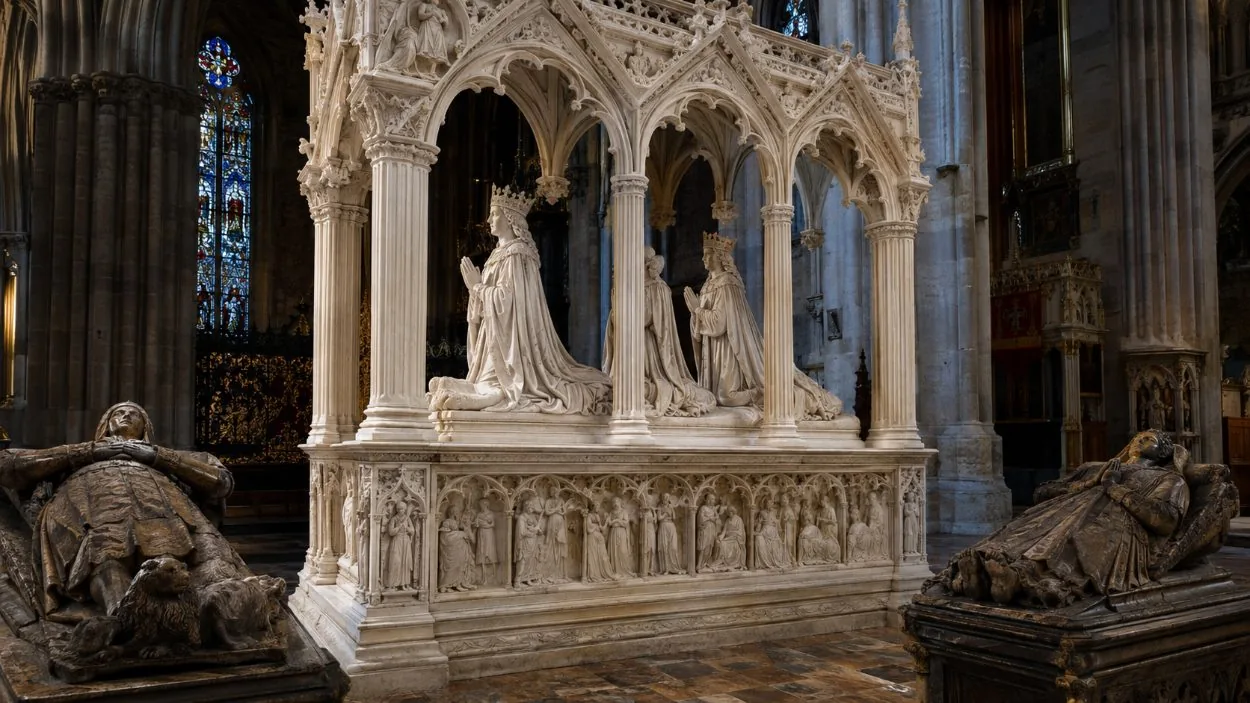
The monuments, however, are not all destroyed. This is why one can still see Dagobert, Louis XII and Anne of Brittany, Francis I, Henry II, and Charles V today. Some of the tombs are dismantled, scattered, and stored away, and will return later; what is lost for good are the bodies.
1817: Louis XVIII has the graves reopened
Twenty-four years later, the Restoration wants to make amends. Louis XVIII has the remains from the two graves recovered. The problem is immediate and insoluble: there is no way to tell which bone belongs to whom. The lime has done its work, the bodies were mixed when placed in the grave, and no method of the time can resolve this. The decision is therefore made to deposit the entire mixed collection in an ossuary in the crypt, behind a plaque bearing the list of sovereigns. This is still the current state, described on the crypt page.
The two remains that are exceptions
Louis XVI and Marie-Antoinette were not in the tombs of Saint-Denis in 1793: guillotined, they had been buried in the Madeleine cemetery. In January 1815, their remains were sought, found, and brought back here. Louis XVIII had two funerary praying statues erected for them, works by Edme Gaulle and Pierre Petitot. These are therefore the only two sovereigns whose exact resting place is known for certain. Details on their page.
The recurring question of Marie-Antoinette’s head is settled here: it was buried with the body at the Madeleine and transferred with it. Nothing is lost. See her page.
Louis XIV and the legend of the heart
Louis XIV, buried here in 1715, is among the bodies destroyed in 1793. There is no tomb of Louis XIV to see. However, a persistent story circulates: his heart, removed and kept separately, was allegedly sold to a painter who turned it into a brown pigment, then swallowed by an English collector. This is an unverifiable anecdote. I recount it only because it is often asked about, never as a fact: it remains a legend until someone produces evidence. Details are on the Louis XIV page.
What works
- An episode that explains everything else about the visit
- The funerary monuments, however, largely survived
- The ossuary in the crypt makes history visible in a single object
- The included guided tours recount the episode on site
Good to know
- No royal tomb is intact: these are empty monuments
- The bones will never be reassigned
- Online accounts often mix up 1793, 1815, and 1817
- The story of Louis XIV’s heart is unverifiable: be wary
Read this page before you come, not after. Visitors who discover on site that the tombs are empty leave disappointed; those who knew look at the sculpture for its own sake and go down to the crypt with a specific reason. See the crypt.
After 1817
The 19th century continued to remodel the building. It was also the century that cost it its second tower: weakened by storms, including that of June 1845, the north tower and its spire were dismantled stone by stone between 1846 and 1847 by the architect François Debret. It has never been rebuilt — until the current project, described on La Fabrique de la Flèche and on why only one tower.
Come and see what remains of it
Reminder: what you’re booking above is entry to the royal necropolis. The nave, however, remains open without a ticket, as in any church in the diocese.
Frequently asked questions
What happened in 1793 at Saint-Denis?
The royal tombs were opened by decree of the Convention, the lead from the coffins was recovered for the war, and the remains were thrown into two mass graves with lime. See who is buried here.
Were the bodies returned to their tombs?
No. Surveyed in 1817 by Louis XVIII, they were impossible to reassign and were placed mixed together in an ossuary in the crypt. See the crypt.
Is anything left of the tombs?
Yes, the monuments themselves: over seventy recumbent statues and tombs, including those of Dagobert, Francis I and Louis XII. See the recumbent statues.
Were Louis XVI and Marie-Antoinette desecrated?
They were not at Saint-Denis in 1793, but at the cimetière de la Madeleine; their remains were brought here in January 1815. See their page.
Was the heart of Louis XIV really eaten?
This is an unverifiable legend, not an established fact. His body, however, was among those destroyed in 1793. See the Louis XIV page.