Why the kings at Saint-Denis
The saint first, the king second
The order matters. Saint-Denis is not a royal cemetery to which a church was added: it is a martyr’s tomb around which a church, then an abbey, then a necropolis were built. Denis is the first bishop of Paris. He is beheaded around 250 on the hill that has since been called mons martyrum, the hill of martyrs, now Montmartre. A 9th-century legend tells that he picked up his head, washed it at a fountain, and walked north for about six kilometres before falling: that is where he was supposedly buried. Historically, what we can confirm is that a venerated martyr’s tomb existed on the site as early as the 3rd or 4th century. The walk, however, is a later tale. I distinguish between the two on the page about Saint Denis.
Being buried near a saint, in the medieval mindset, means placing oneself under his protection at the time of Judgement. The Frankish kings do no differently than the faithful, only on a grander scale. And here, the saint protects a place, an abbey, and a dynasty at the same time.
Dagobert, 639
Dagobert is the first king buried on the site, and he establishes a practice that will become a rule. His current monument dates from the 13th century, six hundred years after his death: it is already a reinterpretation, a staging of origins by a monarchy that needs to assert its antiquity. The sculpted scene depicts the journey of his soul, snatched from demons by Saint Denis himself. Nothing is neutral in this. The details are on the page about the gisants.
Suger, or the abbey as an argument
Abbot Suger led the abbey from 1122 to 1151. He was an advisor to kings, regent during the crusade, and turned Saint-Denis into the place where the monarchy tells its story. On 11 June 1144, the choir he had built was consecrated: pointed arches, ribbed vaults, an ambulatory with radiating chapels opening onto one another, walls replaced by glass. This is the birthdate of Gothic architecture, and its doctrine is summed up in two Latin words, lux nova, the new light. A king buried here is no longer merely buried near a saint: he is buried in the most modern building in Christendom. I recount Suger’s story on his page and his stained glass on the stained glass page.
Continuity as a political tool
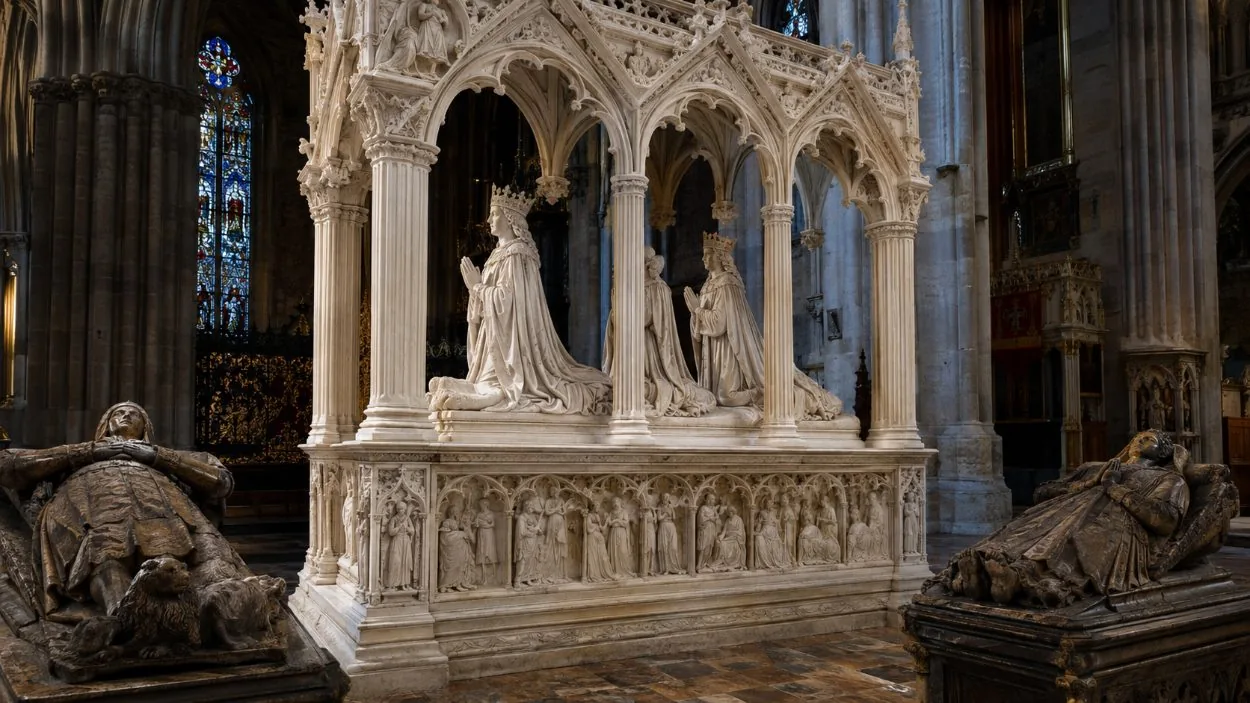
Aligning the tombs means aligning the reigns. In the 13th century, under Louis IX, a campaign of recumbent statues was commissioned to represent earlier kings: a retrospective gallery of portraits was created, making visible at a single glance the continuity of the Merovingian, Carolingian and Capetian dynasties. This is not nostalgia, it is an argument. At the same time, the nave and transept were rebuilt in Rayonnant Gothic, starting in 1231, by Pierre de Montreuil.
The series continues until the Revolution. It is broken in 1793, when the Convention orders the tombs to be opened — the episode is recounted on the 1793 page —, then artificially resumed by the Restoration: Louis XVIII brings back Louis XVI and Marie-Antoinette in January 1815, has the bones from the mass graves raised in 1817, and is himself buried here in 1824. He is the last.
What works
- A single place tells eleven centuries of monarchy, without moving
- The building itself is part of the argument: Gothic invented on site in 1144
- The 13th-century gallery of recumbent statues reads like a stone genealogy
- The link with Montmartre gives a second half to the story
Good to know
- The visible continuity is partly reconstructed after the fact
- The tombs themselves were destroyed in 1793
- The recumbent statues prior to the 13th century are not portraits
- All of this is found in the paid section, not in the free nave
Visit Montmartre and Saint-Denis in the same trip, in this order: the hill where he was beheaded, then the church where he was buried. Six kilometres of legend between the two. The walk on the hill is on the Montmartre page.
The monument and its owners
Today, the building belongs to the State and is managed by the Centre des monuments nationaux, while worship is ensured by the diocese: this dual status explains the free nave and the paid necropolis. Details are available on the owner’s page and on basilica or cathedral. Who exactly rests here? The list is on who is buried here.
Come and see the series
Reminder: what you’re booking above is entry to the royal necropolis. The nave, however, remains open without a ticket, as in any church in the diocese.
Frequently asked questions
Why are the kings of France buried at Saint-Denis?
To be buried near the tomb of Saint Denis, a martyr beheaded around 250, venerated on the site from the 3rd-4th century. See the legend of Saint Denis.
What is the first king buried here?
Dagobert, who died in 639. His monument, from the 13th century, depicts the journey of his soul in sculpted scenes. See the gisants.
Who is the last?
Louis XVIII, in 1824, the same who had the bones from the pits exhumed in 1817. See the desecration of 1793.
What role did Abbot Suger play?
Abbot from 1122 to 1151, advisor to the kings, he had the choir consecrated on 11 June 1144, inaugurating Gothic architecture. See Suger and the Gothic.